




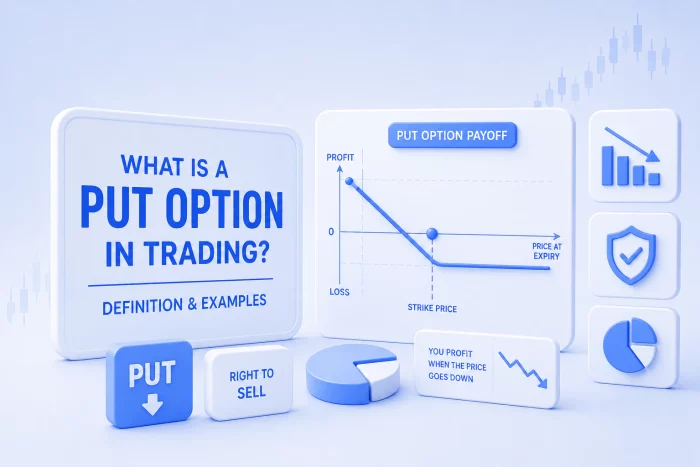
A Put option in binary options is a prediction that the price of an asset will be lower at the moment of expiry than it was at the moment you entered. If price is below your entry price (strike price) at expiry — even by a single tick — you win the payout.
How a Put Works
Gold is trading at $2,350. You believe it will fall in the next 30 minutes. You select Put, stake $10, 30-minute expiry.
At expiry:
- Gold is at $2,344 (lower than $2,350) → Put is correct (In the Money) → You receive $10 + payout
- Gold is at $2,358 (higher than $2,350) → Put is incorrect (Out of the Money) → You lose $10
When to Use a Put
A Put is placed when your analysis suggests downward price movement:
- Price is in a downtrend and rallying to resistance
- RSI is falling from overbought territory
- A bearish candlestick pattern (bearish pin bar, shooting star, bearish engulfing) at resistance
- Momentum indicators confirm downward direction
The Exact Price Rule
Identical to Call: only the price at the precise moment of expiry determines the outcome. A Put that appears profitable mid-session but closes above the entry price at expiry is a loss.
Related Terms
→ Call Option | Strike Price | Expiry Time | Out of the Money | Payout Rate
You Might Also Like

What Is Momentum in Trading?
Momentum is the rate at which price is moving in a given direction — how fast and with how much...

What Is Divergence in Trading?
Divergence occurs when the direction of a momentum indicator disagrees with the direction of price. Price makes a new high,...

What Is a Candlestick? Full Guide
A candlestick is a chart element that displays four key pieces of price information for a defined time period: the...