





DISCLAIMER: This content is for informational and educational purposes only. It does not constitute financial advice. Binary options and event contracts are speculative instruments. Trading involves significant risk of loss, including the possible loss of all capital. No risk management system can guarantee a profitable outcome or prevent all losses. Verify the regulatory status of any platform before depositing funds
- What Is Risk Management in This Context?
- How Binary Options and Event Contracts Handle Risk Differently
- Fixed Risk Is Not Zero Risk
- The Math You Need to Understand: Breakeven Win Rate
- How to Size Your Trades
- The Daily Loss Limit
- The Trade Count Limit
- What Happens During a Losing Streak
- Why Martingale Is Especially Dangerous Here
- How to Avoid Overtrading
- Pre-Trade Checklist
- Why No Risk System Eliminates Risk
- Key Takeaways
- FAQ
Risk Management for Binary Options and Event Contracts
Risk management is the foundation on which any sustainable approach to trading is built. Without it, even a well-structured analytical approach will eventually produce account-level losses that cannot be recovered from. With it, a trader who is wrong more than right can still survive long enough to improve.
This guide covers the practical elements of risk management specifically for binary-style and event contract instruments traded on regulated U.S. exchanges — including how these contracts handle risk structurally, what that means for trade sizing, how to set daily limits, and what no risk system can actually do for you.
What Is Risk Management in This Context?
Risk management, in the context of short-duration speculative contracts, is the set of decisions you make before placing a trade — not during or after — about how much capital you are willing to expose to loss, and under what circumstances you will stop trading for the day.
It is not a strategy for selecting trade direction. It is not a system for predicting market outcomes. It is a set of rules that determine the maximum damage any single session, any single trade, or any losing streak can do to your account.
The CFTC-regulated exchange Nadex describes risk management as «the steps you take to ensure the outcomes of your trades are manageable for you financially» — emphasizing that it is an ongoing process, not a one-time decision.
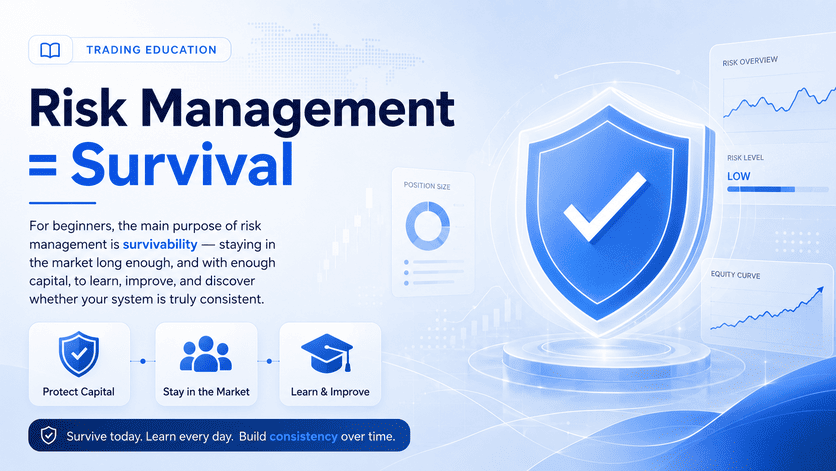
For beginners, the most important function of risk management is survivability: staying in the market long enough — with enough remaining capital — to learn, improve, and determine whether your approach has any real consistency.
How Binary Options and Event Contracts Handle Risk Differently
One of the structural features of binary-style contracts traded on regulated U.S. exchanges is that the maximum loss on any single trade is defined before you enter it. On a CFTC-regulated exchange offering contracts priced between $0 and $10, the maximum you can lose on a single contract is the amount you paid to enter it. You cannot lose more than that.
This is meaningfully different from leveraged instruments — such as futures or margin-based forex trading — where losses can exceed the initial deposit. With a fixed-outcome contract, the worst-case scenario per trade is known in advance.
However, this structural feature is frequently misunderstood as implying lower overall risk. It does not.
The risk is not eliminated — it is defined. And the speed at which fixed-outcome contracts settle means that losing trades accumulate quickly across a session. A series of ten consecutive losing trades, each risking $20, produces a $200 loss in the time it takes to place and settle ten contracts. Without defined limits, a single session can deplete a significant portion of an account.
Fixed Risk Is Not Zero Risk
Beginners sometimes interpret the defined-risk structure of binary-style contracts as meaning these are «safer» instruments than leveraged alternatives. This reasoning is flawed in two important ways.
First: The frequency of settlement magnifies the effect of individual trade losses. Unlike a position that is held for days or weeks and reviewed periodically, binary contracts can settle in minutes. An undisciplined trader can place — and lose — more trades in an hour than a traditional stock investor might in a month.
Second: The all-or-nothing settlement structure means there is no partial recovery mechanism. In many instruments, a position that is moving against you can be reduced or closed early to limit the damage. On standard binary contracts, once entered, the outcome is determined entirely at expiration. Either the full trade amount is returned (plus the payout) or it is lost entirely.
On some regulated platforms, such as CFTC-registered exchanges, it is possible to exit a contract before expiration by selling it back to the market. This adds flexibility, but also introduces additional decisions and costs. Beginners should understand whether the specific platform and contract type they are using allows early exit before assuming this option is available.
Fixed maximum loss per trade does not mean low overall risk. The speed of settlement and the all-or-nothing structure make trade sizing and daily limits essential — not optional.
The Math You Need to Understand: Breakeven Win Rate
This is the calculation that most beginner guides skip entirely, and it is the most important number to understand before placing any real-capital trade.
Because binary-style contracts typically pay out less than 100% on winning trades — meaning a $20 trade that wins returns $20 plus a percentage, not double the stake — you need to win more than 50% of your trades just to break even over time.
The formula is straightforward:
| Выплата при выигрыше | Минимальная доля прибыльных сделок для безубыточности |
|---|---|
| 70% | Около 59% сделок должны быть прибыльными. |
| 80% | Около 56% сделок должны быть прибыльными. |
| 90% | Около 53% сделок должны быть прибыльными. |
| 100% (теоретически) | Ровно 50% прибыльных сделок достаточно для безубыточности. |
The formula: Breakeven Win Rate = 100 ÷ (100 + Payout %)
Example: If a contract pays 80% on winning trades, breakeven win rate = 100 ÷ 180 = 55.6%. You must be correct more than 55.6% of the time — across a meaningful sample of trades — just to not lose money.
This means that a coin-flip approach to trade direction — effectively random entry — will produce losses over time on most binary-style contracts due to the payout structure. This is why a defined approach matters, and also why no approach is self-evidently profitable without evidence from real trading over a substantial number of trades.
Risk management cannot change this math. What it can do is ensure that while you are determining whether your approach produces consistent results above the breakeven threshold, you do not run out of capital in the process.
How to Size Your Trades
The percentage-of-balance method
The most widely cited rule in risk management for binary-style trading is to risk no more than 1–2% of your total account balance on any single trade. This is sometimes presented as a fixed dollar amount, but the percentage approach is structurally stronger because it scales with your account — automatically reducing in absolute terms as your balance decreases during a losing streak.
| Account Balance | 1% per trade | 2% per trade |
| $500 | $5 per trade | $10 per trade |
| $1,000 | $10 per trade | $20 per trade |
| $2,000 | $20 per trade | $40 per trade |
| $5,000 | $50 per trade | $100 per trade |
At 1% per trade, a trader with a $1,000 account would need to lose 100 consecutive trades to lose the entire account — an extreme and statistically rare scenario. At 10% per trade, the same account would be significantly depleted after just 10 consecutive losses.
Some conservative guidelines recommend even lower percentages — 0.5% per trade — for very short-duration contracts where the frequency of settlement is high.
What this rule does not do
Percentage-based trade sizing does not make winning more likely. It does not improve your analytical accuracy. It does not protect you from structural risks of the instrument. What it does is slow the rate of account depletion, giving you more time and more trades to determine whether your approach produces consistent results.
Never increase trade size after a win or after a loss. Sizing decisions should be made before the session begins and remain fixed throughout. Changing size based on recent results is one of the most reliable paths to rapid account depletion.
The Daily Loss Limit
A daily loss limit is a predefined threshold — expressed as a percentage of account balance or a fixed dollar amount — at which you stop trading for the day, regardless of how confident you feel about the next trade.
The purpose is to prevent a bad session from becoming a catastrophic one. Without a daily loss limit, a trader who has already lost 15% of their account in a single session may continue trading in an attempt to recover — and often makes decisions that are increasingly emotional and decreasingly analytical.
Common daily loss limit benchmarks
- Conservative: 3–5% of account balance per day
- Moderate: 5–8% of account balance per day
- Aggressive (not recommended for beginners): 10% or more
Example: A trader with a $1,000 account sets a daily loss limit of 5% ($50). If total losses reach $50 in a session, trading stops — no exceptions. The loss for that day is $50, not $200, not $500.
Setting the limit is straightforward. Following it is the actual challenge. The daily loss limit is tested most severely precisely when it is most important — after a series of losses, when the emotional impulse to recover is strongest.
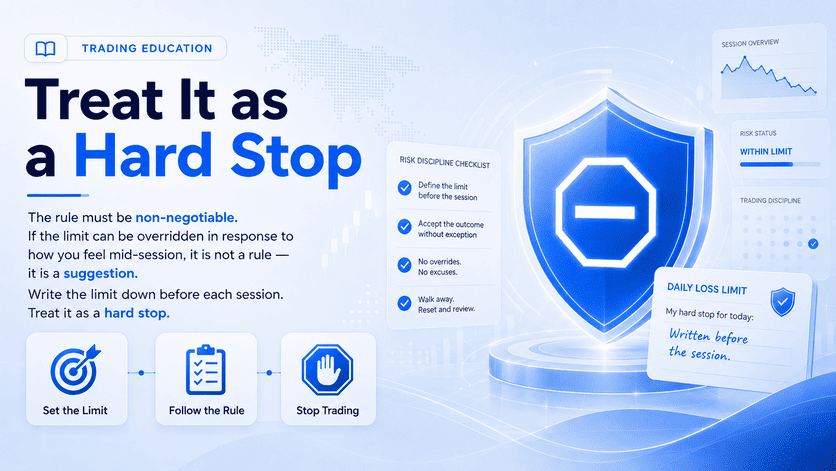
The rule must be non-negotiable. If the limit can be overridden in response to how you feel mid-session, it is not a rule — it is a suggestion. Write the limit down before each session. Treat it as a hard stop.
The Trade Count Limit
In addition to a daily loss limit, many experienced traders set a maximum number of trades per session. This addresses a separate risk: overtrading — placing trades out of boredom, impatience, or the compulsion to be active in the market, rather than because a defined condition has been met.
A trade count limit forces a pause after a defined number of trades. This pause provides an opportunity to review whether the session’s trades followed the defined approach, whether conditions have changed, and whether continuing to trade is appropriate.
Example limit structures:
- No more than 5 trades per session
- No more than 3 trades per hour
- Stop after 2 consecutive losses within a session — regardless of the daily limit remaining
Trade count limits are especially relevant for very short-duration contracts — those expiring in 5 to 15 minutes — where the frequency of potential entries is high and the temptation to trade continuously is significant.
What Happens During a Losing Streak
A losing streak is a sequence of consecutive losing trades. Every approach to speculative trading — however well-structured and analytically sound — will produce losing streaks. This is not a failure of the approach. It is a statistical reality.
For a trader with a 55% win rate — meaning they win 55 out of every 100 trades on average — the probability of experiencing five consecutive losses at some point over hundreds of trades is near certainty. The question is not whether losing streaks will occur, but whether your trade sizing and daily limits protect your account when they do.
How to respond to a losing streak
✓ Stop trading for the day when the daily loss limit is reached
✓ Review the trades in the losing streak before the next session — not to reverse course immediately, but to understand whether losses reflect market conditions or deviations from your defined approach
✓ Consider temporarily reducing trade size during a sustained difficult period — not as an emotional response, but as a measured adjustment
✓ Do not change your analytical approach based on a short losing streak alone — short sequences are statistically insufficient evidence of strategy failure
✗ Do not increase trade size to recover losses — this compounds the problem
✗ Do not continue trading after the daily loss limit is reached because the next setup ‘looks better’
✗ Do not assume a losing streak means the approach is permanently broken — statistical variance is real
The hardest part of managing a losing streak is that the decisions required — smaller sizes, fewer trades, or stopping entirely — feel directly opposite to what the emotional response calls for.
Why Martingale Is Especially Dangerous Here
The Martingale approach involves doubling trade size after each loss, with the logic that a single win will recover all previous losses and produce a profit. It appears mathematically logical in isolation.
In practice, for binary-style and event contract trading, it is one of the most reliable ways to deplete an account rapidly.
The structural reasons:
- Losing streaks are longer than intuition suggests. A 5-trade losing streak with initial size $10 would require a 6th trade of $320 to recover all losses under Martingale. A 7-trade losing streak requires a recovery trade of $1,280. These amounts quickly exceed account balance or platform trade limits.
- All-or-nothing settlement amplifies the damage. Because there is no partial win or loss, each Martingale step is entirely at risk. A single out-of-the-money outcome during a recovery sequence resets all progress and increases the required next-trade size.
- The frequency of settlement accelerates the sequence. A Martingale sequence that might unfold over days in other instruments can reach account-threatening sizes within a single session when contracts expire in minutes.
Martingale and similar progressive staking systems are not risk management strategies. They are capital acceleration methods that shift risk forward in time, not eliminate it. Avoid all progressive sizing systems.
How to Avoid Overtrading
Overtrading — placing trades outside of your defined conditions, or trading more frequently than your risk limits support — is one of the most common causes of preventable losses.
The causes of overtrading are almost entirely psychological:
- Boredom during slow market periods
- The impulse to «be in the market» at all times
- Attempting to recover losses with additional trades
- FOMO — the perception that a setup is going to work and the urgency to enter immediately without confirming conditions
- Winning streak confidence — believing recent wins make the next trade more likely to succeed
Practical measures to prevent overtrading:
- Define entry conditions before each session. Only enter a trade when all defined conditions are met. If you cannot clearly articulate why you are entering a trade, do not enter it.
- Set a trade count limit. A maximum number of trades per session removes the option of continuous trading by design, not willpower.
- Step away from the platform after each trade. Do not immediately evaluate the next potential entry while the previous trade is still settling or immediately after a loss.
- Use the daily loss limit as an automatic circuit breaker. Once the limit is reached, the session is over. No exceptions.
Top Broker Picks for 2026
Three platforms that ranked highest in our real-account testing this year.



Pre-Trade Checklist
Before placing any trade, work through this checklist. If any item is unchecked, do not enter the trade.
☐ I have defined the condition that triggers this entry — it is not based on impulse or urgency
☐ The trade amount does not exceed my per-trade risk percentage (1-2% of current balance)
☐ I have not already reached my daily loss limit
☐ I have not exceeded my maximum trade count for the session
☐ I understand the expiration time of this contract and it aligns with my approach
☐ I understand the payout structure — and what percentage of trades I need to win to break even
☐ I have not placed this trade to recover a previous loss
☐ I am not trading based on boredom, frustration, or excitement from a recent win
☐ The platform I am using is registered with the CFTC or the appropriate U.S. regulator
This checklist serves two purposes: it prevents impulsive trades, and it provides a record — if you review it honestly after sessions — of when and why you deviated from your rules.
Why No Risk System Eliminates Risk
This is the most important thing to understand about risk management: it is a framework for managing the consequences of being wrong — not a tool for being right more often.
A well-constructed risk management approach — 1-2% per trade, defined daily loss limit, trade count limit, no Martingale — will not improve your win rate. It will not make your analysis more accurate. It will not make binary options or event contracts less speculative.
What it does is control the rate and ceiling of losses. A trader with poor analytical accuracy but excellent risk management will lose their account more slowly than a trader with poor risk management — giving them more time to improve, refine, or decide that this type of trading is not appropriate for them.
There is no threshold of risk management sophistication that transforms speculative trading into a reliable income source. This is as true for institutional traders as for retail beginners.
The CFTC and other regulatory bodies consistently note that trading in speculative instruments involves substantial risk of loss and is not suitable for all investors. Risk management is a discipline for operating within that reality — not a way to escape it.
Key Takeaways
KEY TAKEAWAYS
✓ Fixed maximum loss per trade does not mean low overall risk — the speed of settlement and all-or-nothing structure make trade sizing and daily limits essential
✓ The breakeven win rate for binary-style contracts is above 50% — you need to be right more often than a coin flip just to not lose money over time
✓ Risk no more than 1–2% of your account balance per trade — this slows account depletion and gives you time to determine whether your approach produces consistent results
✓ Set a daily loss limit before each session and treat it as non-negotiable — the limit must not be overrideable based on in-session emotion
✓ Losing streaks are statistically inevitable — the appropriate response is to stop or reduce size, not to increase trade size to recover
✓ Martingale and progressive staking systems are not risk management — they shift risk forward in time and accelerate account depletion
✓ No risk management system eliminates the possibility of loss — it controls the ceiling and rate of losses while your approach is being evaluated
FAQ
How much should I risk per trade in binary options or event contracts?
A widely accepted starting point is 1–2% of your total account balance per trade. At 1%, a $1,000 account would risk $10 per trade. This percentage-based approach automatically scales down in absolute terms as your balance decreases, providing a natural brake on losses during difficult periods. Some conservative guidelines recommend as low as 0.5% for very short-duration contracts.
What is a daily loss limit and how do I set one?
A daily loss limit is a predefined dollar amount or percentage of account balance at which you stop trading for the day. A common starting range is 3–5% of account balance. Example: a $1,000 account with a 5% daily limit stops trading for the day once total session losses reach $50, regardless of how many trades remain within your trade count limit.
What is the breakeven win rate for binary options?
The breakeven win rate depends on the payout percentage offered by the contract. If a contract pays 80% on winning trades, you need to win approximately 55.6% of trades over time just to break even. If the payout is 70%, the breakeven win rate is approximately 59%. This is why a random or near-random approach to trade direction will produce losses over time on most binary-style contracts.
Why is Martingale dangerous for binary options and event contracts?
Martingale involves doubling trade size after each loss. Because binary contracts can settle in minutes and losing streaks can extend to five or more consecutive trades, the required recovery trade size quickly exceeds account balance or platform trade limits. A 7-trade losing streak starting at $10 would require an $1,280 recovery trade under Martingale. The all-or-nothing settlement structure means each Martingale step is entirely at risk.
Does risk management guarantee I won’t lose money?
No. Risk management controls the ceiling and rate of losses — it does not improve analytical accuracy, eliminate losing streaks, or guarantee a profitable outcome. No risk management system can make speculative trading reliably profitable. What it can do is slow account depletion, giving you more time to determine whether your approach produces consistent results above the breakeven threshold.
What is overtrading and how do I avoid it?
Overtrading means placing trades outside of your defined entry conditions — typically driven by boredom, the impulse to recover losses, or excitement after a winning trade. It is avoided through pre-session rules: a trade count limit per session, an entry checklist that must be satisfied before each trade, and a daily loss limit that ends the session when reached.
Can I exit a binary options contract early to manage risk?
On some CFTC-regulated exchanges, it is possible to sell a contract before expiration, limiting the loss if market conditions move against your position. This option is not available on all platforms or all contract types. Verify whether early exit is available on your specific platform and contract before assuming this flexibility exists.
You Might Also Like

What Is Volatility in Trading?
Volatility measures the degree to which an asset's price fluctuates over a given period. High volatility means price is making...

What Is a Turnover Requirement in Binary Options?
A turnover requirement (also called wagering requirement or volume condition) is the total amount of trading volume you must generate...

Stochastic Oscillator Guide 2026: How to Read Signals
Table of Contents What Is the Stochastic Oscillator? How the Stochastic Oscillator Works Reading the Stochastic Panel — %K and...