




Table of Contents
- What Is a Demo Trading Account?
- How Demo Accounts Work on Regulated Platforms
- What a Demo Account Can Teach You
- What a Demo Account Cannot Teach You
- Demo vs. Real Account: Side-by-Side Comparison
- How to Use a Demo Account Effectively
- How to Keep a Demo Trade Journal
- Common Mistakes Beginners Make on Demo
- When to Consider Moving to a Real Account
- Key Takeaways
- FAQ
DISCLAIMER: This content is provided for informational and educational purposes only. It does not constitute financial advice or a recommendation to open any trading account. Trading involves significant risk of loss. Demo results do not guarantee or predict real-money trading outcomes. Always verify the regulatory status of any platform before depositing funds.
Demo Trading Accounts: What They Can and Cannot Teach Beginners
A demo trading account is one of the most widely recommended tools for beginners — and one of the most misunderstood. It offers genuine value in the right context, but it also creates a false sense of readiness if used incorrectly.
This guide explains what a demo account actually is, what it can teach you, where it falls short, and how to use it as a useful learning tool rather than a substitute for real market experience. The context here is specific: regulated platforms offering event contracts and binary-style products in the United States, where the structure of contracts and the regulatory environment differ significantly from offshore alternatives.
1What Is a Demo Trading Account?
A demo account — sometimes called a paper trading account or virtual trading account — is a simulated trading environment provided by a platform that allows you to place trades using virtual funds rather than real money.
The platform interface, charts, market data, and contract mechanics are typically the same as a live account. What changes is that any gains or losses affect only your virtual balance. You are not depositing or withdrawing real money, and no real financial transaction takes place.
Most regulated platforms offer demo accounts as part of their onboarding process, and many make them available indefinitely — allowing you to return to demo mode when testing a new approach before using real capital.
Important: Even when using a demo account, ensure the platform providing it is registered with the appropriate U.S. regulator. An offshore platform’s demo account does not give you access to a regulated exchange — it gives you practice on an unregistered system. Verify registration status at NFA BASIC (nfa.futures.org/BasicNet) or the CFTC registration database before using any platform, including its demo mode.
How Demo Accounts Work on Regulated Platforms
On a CFTC-regulated exchange offering binary-style contracts or event contracts, a demo account typically functions as follows:
- Virtual balance: You are credited with a virtual dollar amount — often $10,000 or a similar figure — that represents your practice capital. This is not real money.
- Live market data: The charts and contract prices you see reflect real market conditions in real time. You are looking at the same data a live account holder sees.
- Contract mechanics: On platforms offering binary-style contracts priced between $0 and $10 per contract, the demo account shows the same contract pricing structure, expiration times, and settlement rules as the live environment.
- Maximum loss displayed before entry: One of the structural features of regulated binary-style contracts is that your maximum possible loss on a trade is shown before you enter it. This is visible in demo just as it is in live trading.
- Settlement simulation: At contract expiration, the platform simulates whether your trade settled in-the-money or out-of-the-money, and adjusts your virtual balance accordingly.
What the demo account does not simulate with full accuracy: order execution under real market liquidity conditions, spread behavior during volatile periods, and — most importantly — the psychological experience of risking real money.
What a Demo Account Can Teach You
Used correctly, a demo account is a genuinely valuable learning tool. Here is what it can realistically teach you:
Platform mechanics
Learning where buttons are, how to select a contract, how to set the trade amount, how to read the expiration time, and how the settlement process works — all of this is legitimately learned on a demo account. Making platform errors with real money is avoidable, and demo accounts remove that cost entirely.
Contract structure
Demo trading lets you observe how binary-style contracts are priced, how the price changes as market conditions shift, and what in-the-money versus out-of-the-money settlement looks like in practice. Understanding the mechanics of the specific instrument you plan to trade is foundational.
Strategy testing — at a basic level
You can test whether a rule-based approach — for example, only entering a contract when a specific condition is met — produces a pattern of results in the demo environment. This is useful for evaluating whether a strategy has any logical structure. However, demo results are not proof that a strategy will perform similarly with real capital.
Trade timing and expiration management
Demo trading allows you to practice selecting expiration times that align with your analysis. For event contracts and binary-style products, the expiration is a core part of the trade decision — not an afterthought. Demo is a useful environment for developing judgment around timing.
Journaling habits
Demo trading gives you a low-stakes environment to develop the habit of recording trades, including the reasoning behind each entry, the outcome, and what you observe after the fact. This habit — if built during demo — carries over to real trading.
What a Demo Account Cannot Teach You
This is the part that most beginner guides underweight. The limitations of demo accounts are not minor. They are the reason why profitable demo performance is not evidence that a trader is ready to go live.
Emotional experience
The most significant gap between demo and live trading is psychological. When you trade virtual money, a loss is a number on a screen. When you trade real money — even a small amount — the same loss activates real emotional responses: anxiety, frustration, the impulse to recover the loss immediately, or the urge to abandon a plan that is not yet producing results.
These responses are not character flaws. They are predictable features of human decision-making when real financial consequences are involved. The problem is that demo trading does not activate them. As a result, a trader who appears disciplined on demo — following rules consistently, accepting losses without overreacting — may find that discipline disappears the moment real money is involved.
Execution differences
On a demo account, contract fills are typically immediate and frictionless. In a live environment, brief delays or slight differences in fill prices can occur depending on market liquidity at the moment of entry. For short-duration event contracts, these differences can matter.
Discipline under pressure
Demo trading is, by nature, a low-pressure environment. The absence of real financial consequences means that the psychological cost of deviating from your plan is essentially zero. You can abandon your strategy mid-session on demo with no meaningful consequence. On a real account, the same deviation can produce real losses and reinforce poor habits.
The psychology of a losing streak
Most trading approaches — however well-structured — go through periods where outcomes are predominantly negative. Experiencing a series of losing trades on a demo account does not prepare you for how it feels to experience the same sequence with real money. The impulse to increase trade size to recover losses, to override a plan, or to stop trading entirely is activated by real stakes — not simulated ones.
Demo vs. Real Account: Side-by-Side Comparison
| Factor | Demo Account | Real Account |
| Capital at risk | Virtual — no real money | Real — actual funds |
| Contract mechanics | Identical to live | Identical to demo |
| Market data | Real-time (same feed) | Real-time |
| Order fills | Usually frictionless | May vary with liquidity |
| Psychology activated | Minimal to none | Fear, greed, loss aversion |
| Emotional pressure | None | Present from first trade |
| Discipline tested | Strategy rules only | Strategy + emotional control |
| Losing streak impact | No real consequence | Can trigger impulsive decisions |
| Withdrawal process | N/A | Real fees and timing apply |
| What it proves | Platform mechanics learned | Nothing guaranteed |
How to Use a Demo Account Effectively
The value of a demo account depends entirely on how you use it. Treated as a casual experiment, it produces little learning value. Treated as structured practice with defined goals, it is a genuinely useful preparation stage.
Set a realistic virtual balance
Many demo accounts allow you to set your virtual starting balance. Choose an amount that reflects what you would realistically deposit on a real account — not an inflated figure that removes all sense of constraint. If you plan to start real trading with $500, set your demo balance to $500, not $50,000.
Use the same trade amounts you would use live
Decide, before you start demo trading, how much you would risk per trade on a real account — for example, $10 or $25 per contract. Use that same amount on demo. This makes your demo results more comparable to what you could expect from a real account at the same size.
Define and follow a rule-based approach
Before placing a demo trade, define the condition that triggers your entry. Write it down. Then follow it consistently. If you deviate from the rule, note it. The goal is to build consistent, rule-based behavior — not to generate a positive virtual balance through random or oversized entries.
Set a time boundary
Rather than staying on demo indefinitely until results look favorable, set a specific period — for example, 30 trading days — and evaluate your results at the end of that period. A defined timeframe prevents indefinite delay and forces you to make a structured assessment.
Keep a trade journal from the first day
Record every demo trade: the asset or contract, the direction of your prediction, the amount, the expiration time, the outcome, and your reasoning. Reviewing this log after two or four weeks reveals patterns — including patterns of impulsive or plan-deviant behavior — that would otherwise be invisible.
Top Broker Picks for 2026
Three platforms that ranked highest in our real-account testing this year.



How to Keep a Demo Trade Journal
A trade journal is not a spreadsheet of outcomes. It is a record of decisions. The goal is not to count wins and losses — it is to understand why you made each decision and whether that decision followed your plan.
For each demo trade, record:
| Field | What to Record |
| Date and time | When the trade was entered |
| Asset / Contract | What you were trading |
| Direction | Higher / Lower (or Yes / No for event contracts) |
| Trade amount | Amount entered per contract |
| Expiration time | When the contract settled |
| Reasoning | Why you entered — what condition was met |
| Outcome | In-the-money or out-of-the-money |
| Plan followed? | Yes / No — if no, why not |
| Observation | What you noticed about market behavior or your own reaction |
Review your journal weekly. Look for: trades where you deviated from your plan and why; patterns in which assets or expiration times produce more consistent results; whether your rule-based approach shows any directional consistency over time.
Common Mistakes Beginners Make on Demo
- Using an unrealistically large virtual balance. Trading with $100,000 in virtual funds when you plan to start live with $300 creates habits and risk tolerances that do not transfer to real trading.
- Placing oversized trades because ‘it doesn’t count.’ If your demo trades are 10x larger than what you could realistically afford live, your results are not informative.
- Treating demo success as proof of readiness. Positive demo results reflect strategy logic in a consequence-free environment. They do not prove you can execute the same strategy under real psychological pressure.
- Staying on demo indefinitely. Some beginners use demo as a way to delay the emotional reality of live trading. This delay does not address the skills that only develop with real stakes involved.
- Not journaling. Without a trade log, demo trading produces no structured learning — only a series of outcomes that are quickly forgotten.
- Switching strategies frequently. If each new demo session uses a different approach, you are not testing anything. A demo account is most useful when you apply a consistent, rule-based method over a defined period.
- Using a demo on an unregistered platform. Practicing on an offshore platform’s demo account does not provide any useful information about regulated exchange contract mechanics. Always use a demo on a registered platform.
When to Consider Moving to a Real Account
There is no fixed threshold of demo success that objectively indicates readiness for real trading. But there are meaningful criteria that reduce the risk of transitioning prematurely.
Readiness Checklist
☐ You have clearly defined the rule-based approach you plan to use — written down, not just in your head
☐ You have placed at least 50–100 demo trades following that approach consistently
☐ You have reviewed your trade journal and understand the pattern of your results over time
☐ You have set a realistic trade amount per contract that reflects what you are comfortable losing on a live account
☐ You understand the contract mechanics completely: how pricing works, what triggers settlement, what fees apply
☐ You have verified the platform’s regulatory status through NFA BASIC or the relevant CFTC database
☐ You are prepared to fund only with an amount you can afford to lose entirely without affecting your financial stability
☐ You have not had a period of emotional overtrading or plan abandonment on demo — or if you have, you have identified why and addressed it
Meeting these criteria does not guarantee success on a live account. It reduces the probability that you will be caught off-guard by factors — primarily psychological — that demo trading does not expose you to.
If you are uncertain whether you are ready, the appropriate response is not to push forward — it is to continue on demo with a more structured approach, or to reduce your intended real-account funding to the smallest amount that allows you to trade the minimum contract size on a regulated platform.
Key Takeaways
KEY TAKEAWAYS
✓ A demo account is a valuable tool for learning platform mechanics and testing strategy logic — it is not proof of trading readiness
✓ On regulated platforms, demo accounts reflect the same contract structure as live accounts: defined maximum loss, fixed expiration, real-time market data
✓ The most significant limitation of demo trading is psychological: real financial stakes activate emotions that virtual trading does not
✓ Use demo with a realistic virtual balance, consistent trade amounts, and a structured journal from day one
✓ Positive demo results do not guarantee similar outcomes with real money — past performance does not predict future results
✓ Always verify that the platform offering the demo account is registered with the CFTC, NFA, or the relevant U.S. regulator
✓ Transition to real trading only when you have met structured readiness criteria — not after a few good demo weeks
FAQ
What is a demo trading account?
A demo account is a simulated trading environment that uses virtual funds. It allows you to place practice trades without risking real money. The platform, charts, and contract mechanics are typically identical to a live account — the key difference is that gains and losses affect only your virtual balance.
Do demo accounts use real market data?
Yes, on regulated platforms, demo accounts display real-time market data — the same data that live account holders see. What changes is how orders are filled and, more importantly, the psychological experience of trading with real versus virtual money.
How long should I use a demo account before trading live?
There is no universal timeframe. The more meaningful question is whether you have met specific readiness criteria: a clearly defined approach, a trade journal covering at least 50-100 trades, and an understanding of the contract mechanics and platform. Staying on demo indefinitely does not develop the skills that only emerge with real stakes.
Can I make money on a demo account and lose money on a real one?
Yes, and this is common. Demo profitability reflects strategy logic in a consequence-free environment. It does not test the emotional discipline required to follow that same strategy when real money is at risk. Fear, greed, and loss aversion — which are absent in demo — directly affect real-money trading decisions.
Should I use an offshore platform’s demo account to practice?
No. Practicing on a demo provided by an unregistered offshore platform does not give you relevant experience with regulated contract mechanics. It also does not verify that the platform is safe to deposit real funds with. Always use a demo account provided by a CFTC-registered platform, and verify registration at nfa.futures.org/BasicNet or cftc.gov before using any platform.
What is the best way to use a demo account?
Set a realistic virtual balance matching your planned real deposit. Define and document a rule-based approach before placing any trade. Record every trade in a journal with reasoning and outcome. Set a defined practice period rather than trading indefinitely. Review your journal at regular intervals. The goal is structured learning, not generating a positive virtual balance.
Does demo trading prepare me for the psychology of real trading?
Only partially. Demo trading can help you observe your tendencies — whether you deviate from plans, overtrade, or avoid entering when conditions are met. But the full psychological experience of real financial consequences — loss aversion, fear, greed, impulse to recover losses — only activates when real money is at risk. No demo account fully replicates this.
You Might Also Like
6 Best Pocket Option Alternatives in 2026
If you're comparing Pocket Option alternatives, the first question is not simply “Which broker is better?” A more useful question...
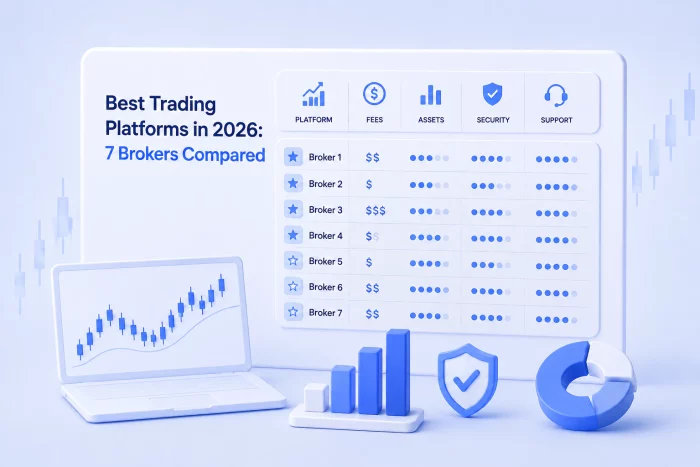
Best Trading Platforms in 2026: 7 Brokers Compared
The best trading platform is not necessarily the one with the longest feature list or the lowest advertised deposit. The...

What Is Volatility in Trading?
Volatility measures the degree to which an asset's price fluctuates over a given period. High volatility means price is making...