





Risk Warning: Binary options trading involves a high level of risk. The majority of retail traders lose money. This article is for educational purposes only and does not constitute financial advice. Never trade with money you cannot afford to lose.
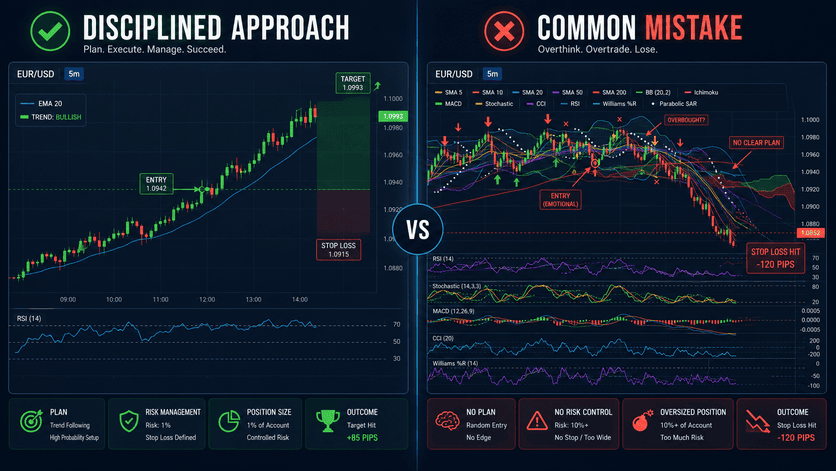
Why Most Binary Options Beginners Fail — And How to Stop
Losing money in binary options is not random. When you study losing traders closely, the same patterns appear over and over again: the same emotional traps, the same analytical errors, the same risk management failures.
This guide catalogs every major mistake beginners make — not just what the mistake is, but why it happens psychologically, what damage it causes, and exactly how to correct it. Work through this list honestly. The traders who improve are the ones who recognize their own behavior in these descriptions.
The Mathematics That Works Against You From Trade One
Before covering individual mistakes, you need to understand the structural challenge built into binary options. This context makes every other mistake more serious.
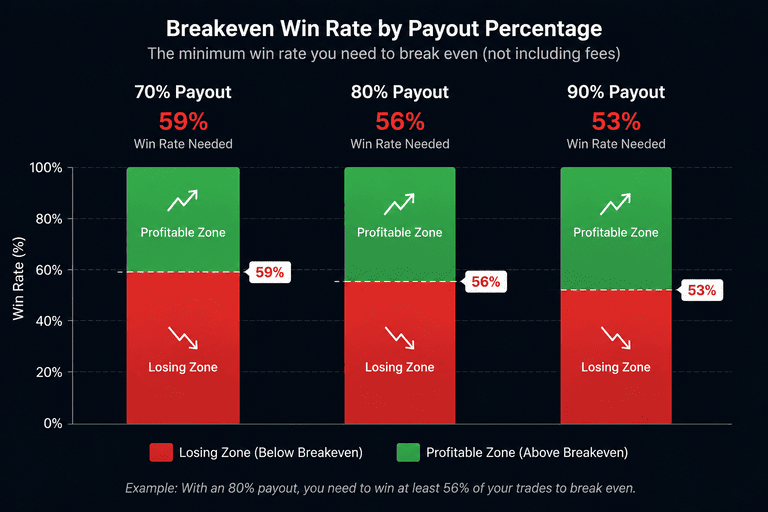
On a standard binary contract with an 80% payout, you receive $80 on a $100 winning trade and lose $100 on a losing trade. The breakeven math:
| Payout Rate | Breakeven Win Rate Required | What This Means |
|---|---|---|
| 70% | 59% of trades must win | Win 6 out of every 10 just to break even |
| 80% | 56% of trades must win | A coin flip loses money over time |
| 90% | 53% of trades must win | Closest to fair, but still requires an edge |
This is not a warning to stop trading. It is a warning that every mistake listed below is more costly than it would be in a market with a symmetrical risk-reward structure. You cannot afford to compound errors.
Money Management
Part 1: Risk Management Mistakes
Mistake 1: Risking Too Much Per Trade
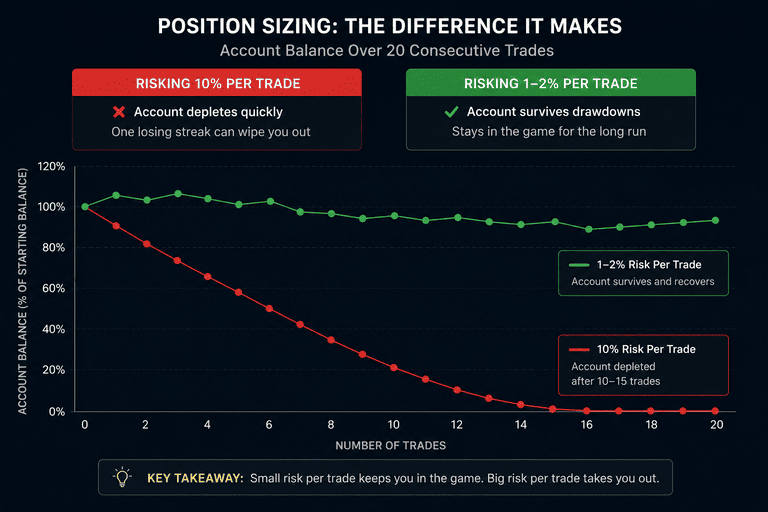
Why it happens: Beginners underestimate how quickly losses compound. A single trade feels like a contained experiment. It is not — it is a percentage of a finite capital pool.
What it causes: A trader risking 10% per trade can be eliminated by ten consecutive losses. At standard payout rates, ten consecutive losses is not a statistical outlier — it is inevitable if you trade long enough.
How to fix it: Limit each trade to 1–2% of your total account balance. This is not conservative — it is mathematically sound. At 1%, a trader with a $500 account risks $5 per trade. The account survives 100 losing trades before ruin. That is enough runway to learn.
| Account Balance | Risk Per Trade (1%) | Risk Per Trade (2%) | Trades Until Ruin at 100% Loss Rate |
|---|---|---|---|
| $500 | $5 | $10 | 100 / 50 |
| $1,000 | $10 | $20 | 100 / 50 |
| $5,000 | $50 | $100 | 100 / 50 |
Key principle: Your job in the early months is not to make money. It is to stay alive long enough to develop a consistent approach.
Risk Management Guide
Mistake 2: Setting No Daily Loss Limit
Why it happens: Without a hard stop, there is always a psychological case for one more trade. «I just need one win to recover» is one of the most dangerous sentences in trading.
What it causes: Traders who lose their session limit and continue place increasingly irrational trades. The emotional state after a losing series is categorically different from the state at session start. Decision quality deteriorates.
How to fix it: Set a daily loss limit before you open your platform — not in the moment. A common guideline: stop trading for the day when you have lost 5–10% of your account. Write the number down. It is non-negotiable.
Pro Tip: If your daily limit is $50 and you hit it at 10 a.m., close your platform and do not reopen it until the next trading session. The market will still exist tomorrow.
Mistake 3: Overtrading
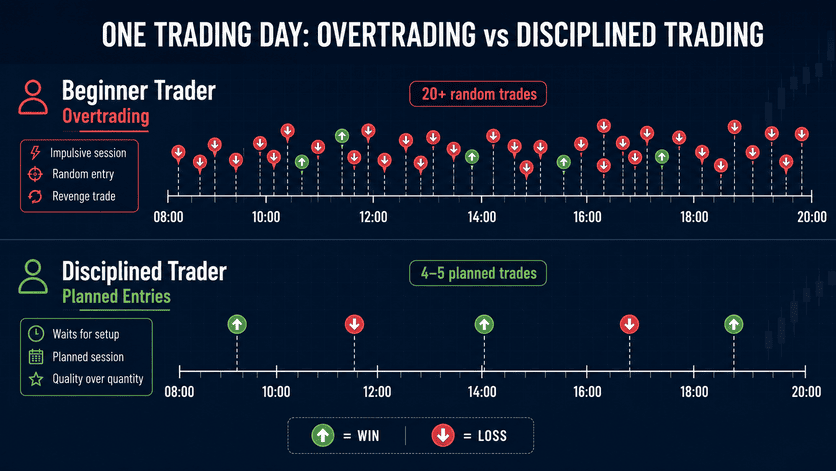
Why it happens: The binary options format creates a behavioral trap. Trades settle in minutes, and each settlement produces a psychological trigger — whether it’s the dopamine of a win or the frustration of a loss — that pushes the trader to act again immediately.
What it causes: Quality of analysis degrades rapidly under high trade frequency. After the fifth trade in 30 minutes, most beginners are no longer analyzing — they are reacting. Reacting without a framework is gambling.
How to fix it: Set a maximum trade count per session before you start. Five trades per session is a reasonable ceiling for beginners. After the fifth trade, regardless of outcome, stop. Review what you did. Resume the next day.
| Behavior | Beginner | Disciplined Trader |
|---|---|---|
| Trades per session | 10–30+ | 3–7 (planned) |
| Entry basis | Feeling, boredom, impulse | Predefined signal only |
| Response to daily limit | Ignores it | Closes platform, stops |
| Trade review | Skips it | Journals every trade |
Part 2: Technical Mistakes
Mistake 4: Entering Before the Candle Closes
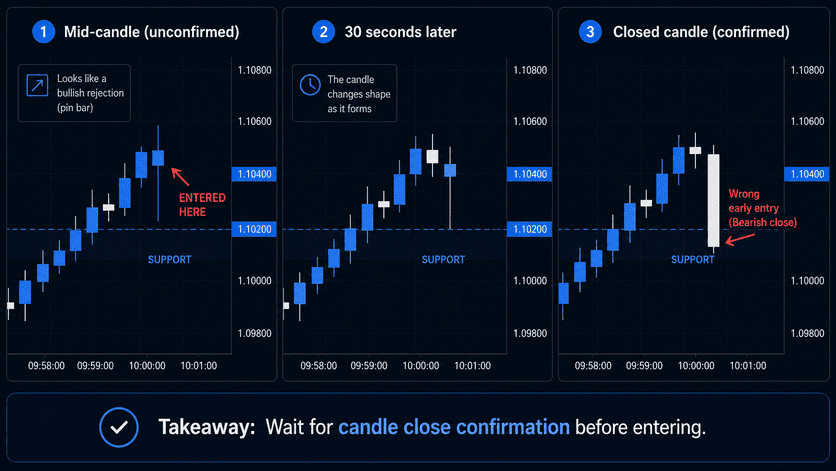
Why it happens: A signal looks perfect in the middle of a candle. The trader fears it will disappear. They enter early.
What it causes: A candle that looks like a bullish pin bar midway through can close as a neutral doji or a bearish candle. Entering before close means entering on an unconfirmed signal — you are paying for a possibility, not a fact.
How to fix it: Only enter after the candle that generates your signal has fully closed. Wait for the next candle to open. This single discipline eliminates a significant category of false signal entries.
Example: RSI drops to 28 with price near support. An unformed pin bar candle begins to form. You enter because it looks promising. The candle closes as a bearish continuation — price keeps falling. Had you waited for the closed candle, the entry would have been skipped.
Mistake 5: Ignoring the Higher Timeframe Trend
Why it happens: Beginners analyze only the timeframe they intend to trade on. A setup that looks bullish on M5 may be forming inside a clear downtrend on M30 or H1.
What it causes: Trading against the trend consistently from a lower timeframe produces a statistical disadvantage. Trend direction matters more than individual signals. Going counter-trend requires more confirmation, not less.
How to fix it: Before entering any trade, check one timeframe higher than your working chart. If the higher timeframe shows a downtrend, only take Put signals on the lower timeframe. If it shows an uptrend, only take Call signals. Never fight the trend without explicit confirmation it has reversed.
Technical Analysis
Mistake 6: Using Too Many Indicators
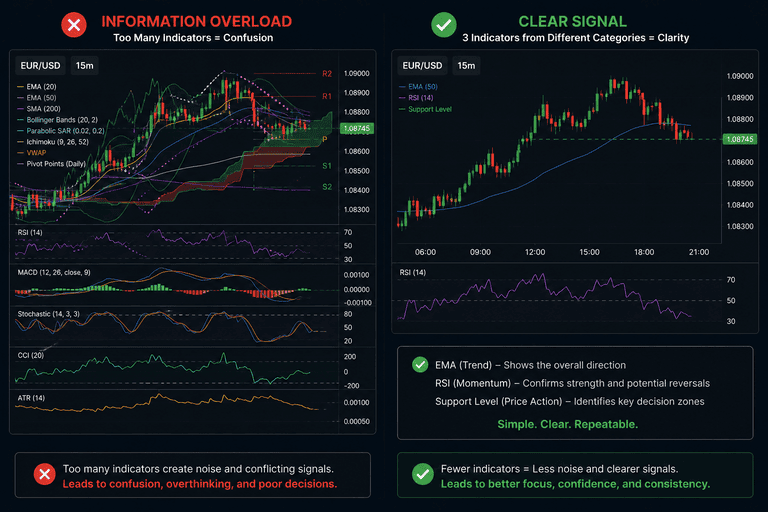
Why it happens: Each indicator, by itself, produces false signals. Beginners believe that adding more indicators will filter out those false signals. The opposite usually occurs.
What it causes: Most indicators are derived from the same price data. Adding RSI, Stochastic, CCI, and MACD to the same chart does not produce four independent opinions — it produces four correlated readings of the same underlying movement. The chart becomes visually cluttered, signals conflict, and the trader either becomes paralyzed or falls back on intuition anyway.
How to fix it: Use one trend indicator (EMA or MACD) and one momentum oscillator (RSI or Stochastic). Add price structure (support and resistance levels). Three elements from different analytical categories provide genuine confluence. More than three creates noise.
Mistake 7: Selecting the Wrong Expiry Time
Why it happens: Expiry selection is treated as an afterthought — traders pick whatever the platform defaults to, or whatever feels right. In reality, expiry is a core component of the trade thesis.
What it causes: A signal based on M15 chart analysis with a 1-minute expiry gives the trade no time to develop. A signal on M5 with a 4-hour expiry exposes the position to far more noise and potential reversal than the analysis justifies.
How to fix it: Match expiry to the timeframe of your signal. A rough guideline:
| Signal Timeframe | Recommended Expiry Range | Why |
|---|---|---|
| M1 | 1–3 minutes | Very short-term momentum only |
| M5 | 5–15 minutes | Signal needs time to play out |
| M15 | 15–30 minutes | Sufficient for trend-based setup |
| M30 / H1 | 30–60+ minutes | Structural moves need room |
Mistake 8: Trading During Major Economic News
Why it happens: The economic calendar requires an extra step. Most beginners skip it. They open their chart, see a setup, and enter — unaware that Non-Farm Payrolls publishes in four minutes.
What it causes: During high-impact news releases (NFP, CPI, Fed rate decisions), price can move 50–150 pips in seconds. Technical signals built over hours become irrelevant in moments. Even a correct directional bias can lose if the volatility spike temporarily moves against the position before the contract expires.
How to fix it: Check the economic calendar every morning before your session begins. Mark all high-impact events. Avoid opening new positions within 30 minutes before or after a high-impact release. This takes 60 seconds and eliminates an entire class of avoidable losses.
Fundamental Analysis
Mistake 9: Changing Strategy Every Few Trades
Why it happens: After three losing trades in a row, confidence in the current approach collapses. The trader abandons it and tries something new. Three losses is not statistical evidence that a strategy is broken — it is normal variance.
What it causes: No strategy can be properly evaluated over fewer than 50–100 trades. A trader who changes approach every week is never running the same system long enough to know if it works. They accumulate confusion instead of data.
How to fix it: Commit to any strategy for a minimum of 50 trades on a demo account before drawing any conclusions. Track every trade. Evaluate the results statistically. Only then decide whether adjustment is warranted — and change one variable at a time, not the entire system.
Trading Strategies
Mistake 10: Not Keeping a Trading Journal
Why it happens: Journaling feels slow and unnecessary when you want to trade. It also forces accountability that many traders prefer to avoid.
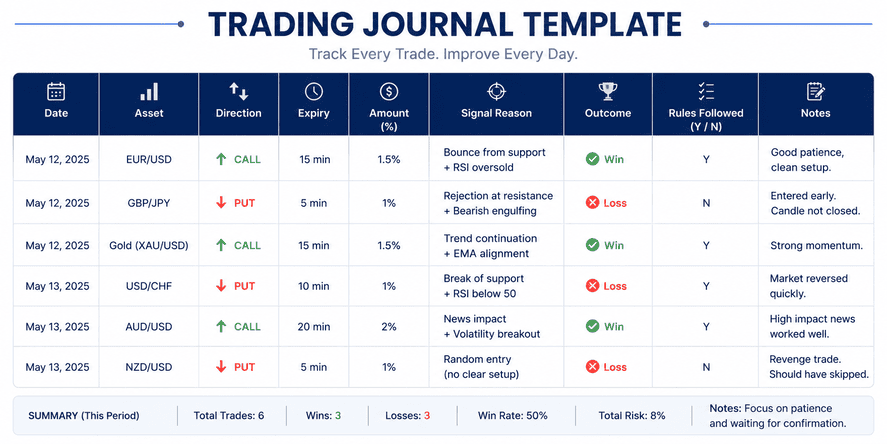
What it causes: Without a journal, every losing trade is forgotten or rationalized. The same errors repeat because there is no record that they happened before. Growth requires pattern recognition — and you cannot recognize patterns you did not record.
How to fix it: Record every trade with the following information:
- Date and time
- Asset traded
- Expiry selected
- Signal or reason for entry
- Direction (Call or Put)
- Amount risked
- Outcome (win / loss)
- Did the trade follow your rules? (Yes / No)
- Any notes on what you observed
Review your journal weekly. The «Did the trade follow your rules?» column is the most important one — it separates strategy performance from behavioral performance.
Demo Account Guide
Part 3: Psychological Mistakes
Mistake 11: Revenge Trading
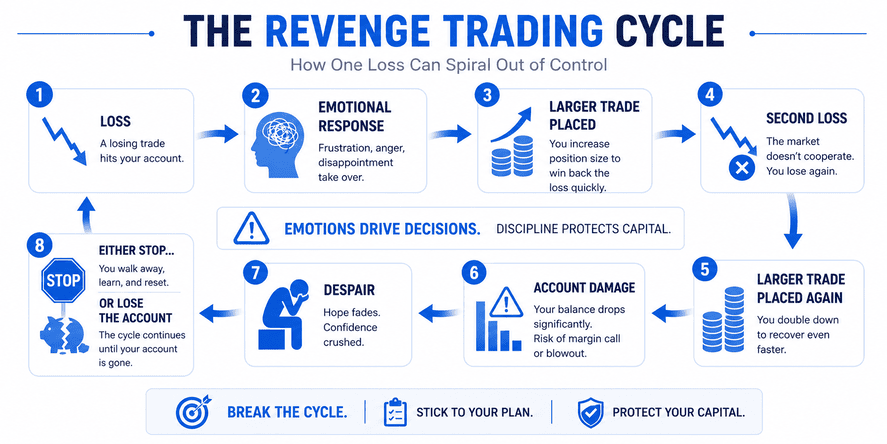
Why it happens: A loss activates a threat response. The brain registers the financial loss as a real threat and generates urgency to recover it. This urgency overrides the analytical processes that govern good trading decisions.
What it causes: The revenge trade is placed at elevated size («to recover faster»), with reduced analysis, in an emotionally agitated state — the worst possible combination. The majority of revenge trades lose, which triggers another revenge trade. This cycle is how accounts are destroyed in single sessions.
How to fix it: Create a mandatory pause rule: after any losing trade, you must wait a minimum of 10 minutes before placing the next one. No exceptions. During that pause, step away from the screen. The trade you want to place immediately after a loss is almost never the trade you should place.
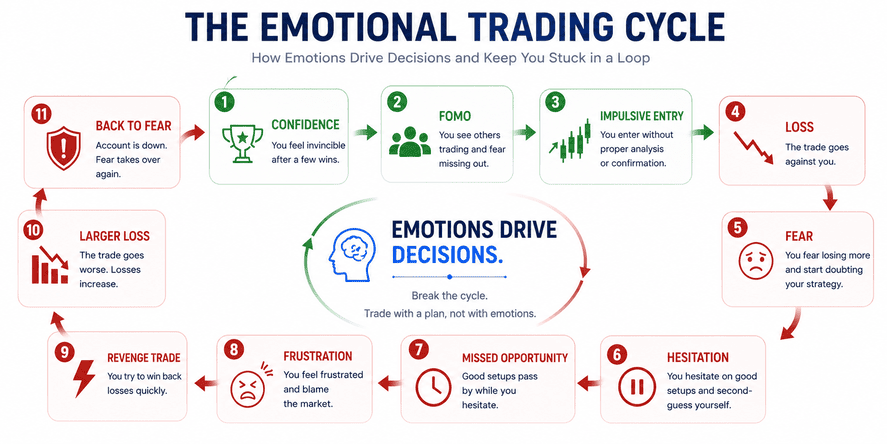
The psychology: Revenge trading is not about the next trade. It is about trying to undo the last one. Since that is impossible, all it accomplishes is adding a second loss to the first.
Mistake 12: Overconfidence After a Winning Streak
Why it happens: Five consecutive winning trades produce a feeling of mastery. Confidence rises. Position sizes increase. Trade frequency increases. Analysis rigor decreases. The trader feels they have «figured it out.»
What it causes: A winning streak of 5 trades has a meaningful probability of occurring by chance even with a random entry system. It does not constitute evidence that the trader has found an edge. When the normal statistical variance produces a losing streak after the winning one, the trader is now operating at larger position sizes with lower analytical discipline — maximizing the damage.
How to fix it: Treat a winning streak the same way you treat a losing streak: with increased caution, not increased size. Keep position size fixed regardless of recent results. Document winning trades as carefully as losing ones — the reason you won is as important to understand as the reason you lost.
Mistake 13: FOMO — Fear of Missing Out
Why it happens: A setup appears to be developing. The trader hesitates. The move begins. Now it looks even more compelling — but the entry point has already passed. Instead of waiting for the next setup, the trader chases the existing move.
What it causes: Chasing a move means entering late, at an unfavorable price, when the highest-probability portion of the signal has already occurred. Late entries have a lower success rate and, in binary options specifically, leave less time for the position to work.
How to fix it: Accept that missed trades are part of trading. The market produces setups continuously. A trade that passed is gone; the next one is coming. Define your entry criteria precisely in advance — if the criteria are no longer met, the trade does not exist. Never modify criteria mid-setup to justify chasing.
Mistake 14: Copying Signals Blindly
Why it happens: Signals promise to remove the analytical burden. A notification arrives, a trade is placed, money is (sometimes) made. This feels like a shortcut to profitability.
What it causes: Signal services have no accountability for your results. They do not know your account size, your risk tolerance, or when you actually execute versus when they send the signal (timing matters enormously in short-expiry binary options). More fundamentally: copying signals teaches you nothing. If the service stops or fails, you have no independent capability.
How to fix it: Use signals only as a secondary learning tool — cross-reference them against your own analysis. Ask yourself: does this signal match what I see on the chart? If you cannot evaluate a signal independently, you are not ready to trade signals. Build your own analytical foundation first.
Part 4: Cognitive Bias Mistakes
These mistakes are not about strategy or technique. They are about how the human brain processes probability — and consistently gets it wrong in trading contexts.
Mistake 15: The Gambler’s Fallacy
Why it happens: After five consecutive Put contracts win, the brain expects the next one to lose — as if the market «owes» a correction to balance the wins. This is a fundamental misunderstanding of probability.
What it causes: Traders alter their strategy based on the recent sequence of outcomes rather than the quality of the current signal. They avoid taking a valid setup because «it’s had too many wins recently.» Or they take a poor setup because «it’s due for a win.»
How to fix it: Each trade is statistically independent of the previous one. The market has no memory. A valid signal on trade 11 is as valid as it was on trade 1. Base every decision on the current signal quality — not on what the last five trades did.
Mistake 16: Confirmation Bias
Why it happens: Once a directional opinion forms («I think EUR/USD is going up»), the brain unconsciously filters information to support that conclusion. Evidence against the view is ignored or rationalized away.
What it causes: Traders enter trades in the wrong direction because they have already decided the outcome before analyzing. They are not analyzing — they are confirming.
How to fix it: Before entering any trade, actively seek evidence against your intended direction. Ask: «What would the chart look like if I am wrong?» If you cannot construct the bearish case when you are bullish, your analysis is incomplete. A trade should emerge from the evidence, not precede it.
Mistake 17: Survivorship Bias and Unrealistic Expectations
Why it happens: Online trading communities feature success stories. Traders who lost their accounts do not post about it. The visible sample is heavily skewed toward wins.
What it causes: Beginners enter the market expecting results that represent the visible outliers, not the statistical majority. When their results match the actual average — which includes significant drawdowns and slow progress — they conclude something is wrong with their approach and seek faster solutions.
How to fix it: Accept the base rate. The majority of retail binary options traders lose money, particularly in the early months. This does not mean success is impossible — it means success requires a longer development timeline and more rigorous approach than the promoted success stories suggest. Measure your progress against a realistic benchmark, not a social media highlight reel.
Mistake 18: Recency Bias
Why it happens: The last few trades feel more relevant than the full statistical history. If the last three trades lost, the current strategy feels like it has «stopped working.» If the last three won, it feels invincible.
What it causes: Strategy decisions are made based on a sample that is statistically meaningless. Three trades proves nothing in any direction.
How to fix it: Evaluate performance only over meaningful sample sizes — minimum 30 trades, ideally 50–100. Maintain a rolling performance log. Make strategy decisions based on the full dataset, not the last session’s results.
Part 5: Structural and Setup Mistakes
Mistake 19: Trading Without a Demo Account Phase
Why it happens: Impatience. The demo environment feels like practice, and practice feels like delay. Beginners want to make real money, so they skip to live trading.
What it causes: The first months of trading with real money are the highest-error period. Mistakes that would be costless on demo — mis-entering an order, using the wrong expiry, failing to understand how a platform confirms a trade — cost real capital when learning on a live account.
How to fix it: Trade on demo until you can demonstrate consistent positive results over 50+ trades with strict rule adherence. Document the trades. Only then make the case for moving to live. Even after going live, return to demo whenever testing new approaches.
Demo Account Guide
Mistake 20: Ignoring Broker Quality
Why it happens: Beginners evaluate brokers based on bonuses, payout rates, and interface aesthetics. Regulatory status and withdrawal reliability are boring — until they are not.
What it causes: An unregulated or poorly regulated broker can refuse withdrawals, manipulate OTC pricing, or close accounts arbitrarily. These events are not theoretical — they are documented regularly in the binary options segment. Choosing the wrong broker can mean losing money that has nothing to do with your trading performance.
How to fix it: Verify every platform’s regulatory status before depositing. In the U.S., check the CFTC Registration database. In the UK, the FCA Register. For international platforms, check the NFA BASIC system and the CFTC RED List of unregistered entities soliciting U.S. clients.
Broker quality also affects trade execution speed, payout reliability, and support quality in disputes — all of which directly impact your trading results.
[[BROKER COMPARISON TABLE]]
Part 6: The Mistake Comparison Table
| Mistake | Category | Consequence | One-Line Fix |
|---|---|---|---|
| Risking too much per trade | Risk Management | Account ruin in a losing streak | Maximum 1–2% per trade |
| No daily loss limit | Risk Management | Full session wipeout | Stop at 5–10% daily loss |
| Overtrading | Risk Management | Analysis degrades, impulsive entries | Maximum 5 trades per session |
| Entering before candle close | Technical | Unconfirmed signal entries | Always wait for candle close |
| Ignoring higher timeframe | Technical | Counter-trend trades | Check H1 before M5 entries |
| Too many indicators | Technical | Conflicting signals, confusion | Maximum 3 indicators from different categories |
| Wrong expiry selection | Technical | Trade has no time to develop | Match expiry to signal timeframe |
| Trading during news | Technical | Unpredictable volatility destroys setup | Check economic calendar daily |
| Changing strategy constantly | Technical | No strategy is ever properly tested | Minimum 50 trades per approach |
| No trading journal | Technical | Same mistakes repeat indefinitely | Record every trade, review weekly |
| Revenge trading | Psychology | Escalating losses in a single session | Mandatory 10-minute pause after a loss |
| Overconfidence after wins | Psychology | Oversized trades during vulnerable period | Keep size fixed regardless of streak |
| FOMO | Psychology | Late entries at poor prices | If criteria aren’t met, skip the trade |
| Copying signals blindly | Psychology | No learning, full dependency | Cross-reference every signal independently |
| Gambler’s fallacy | Cognitive Bias | Strategy distorted by recent sequence | Each trade is independent — judge the signal, not the streak |
| Confirmation bias | Cognitive Bias | Entering before analysis is complete | Actively seek evidence against your bias |
| Survivorship bias | Cognitive Bias | Unrealistic expectations, premature discouragement | Measure against statistical reality, not outliers |
| Recency bias | Cognitive Bias | Strategy decisions based on three trades | Evaluate only over 50+ trade samples |
| No demo phase | Structural | Learning on real capital is expensive | 50+ consistent demo trades before going live |
| Ignoring broker quality | Structural | Withdrawal issues, price manipulation risk | Verify regulatory status before depositing |
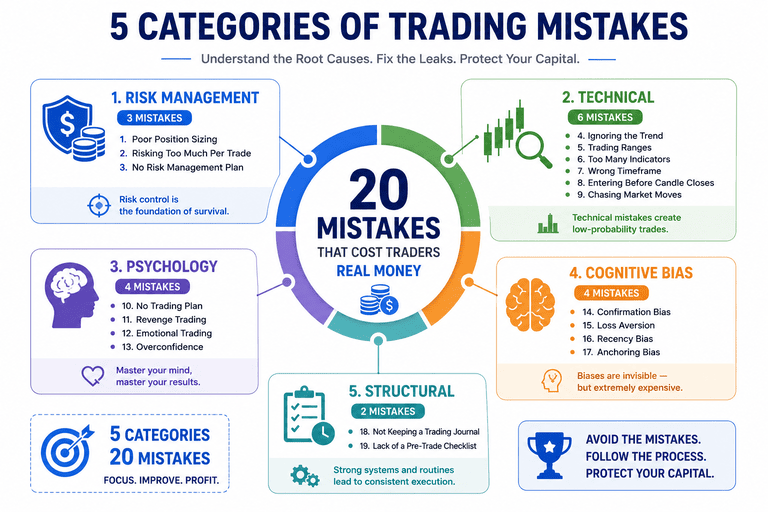
The Pre-Trade Checklist: Run This Before Every Trade
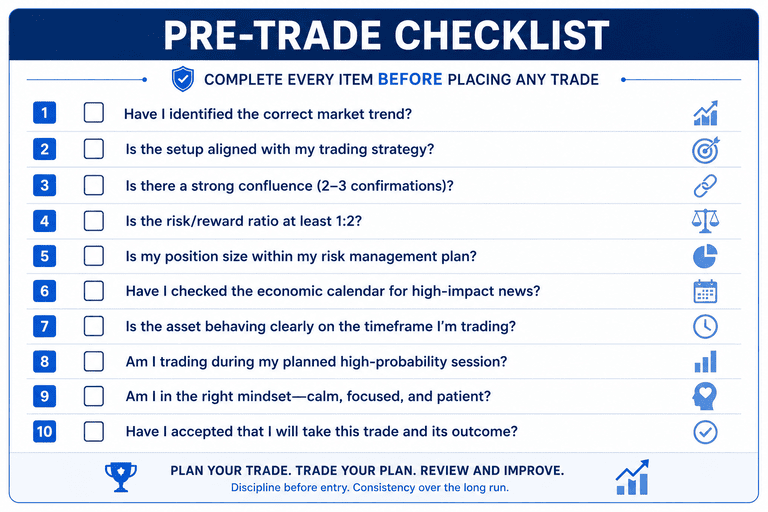
Print this list. Keep it next to your trading setup. Go through it before every entry.
- Have I checked the economic calendar for high-impact events in the next 60 minutes?
- What is the trend direction on the timeframe one level above my working chart?
- Is my signal in the direction of the higher timeframe trend?
- Has the signal candle fully closed before I am entering?
- Am I using two or three indicators from different analytical categories — not more?
- Does my expiry time match the timeframe of my signal?
- Is my trade amount 1–2% of my current account balance?
- Have I already hit my daily loss limit?
- Have I already traded the maximum number of trades I set for today?
- Am I entering because of a clear signal — or because of FOMO, revenge, or boredom?
If any answer creates doubt, skip the trade. There will be another setup. Capital lost on a questionable trade is not recoverable by the next trade — it requires additional winning trades just to return to where you were.
FAQ: Common Binary Options Trading Mistakes
What is the most common mistake binary options beginners make?
Risking too much per trade. Beginners frequently place 5–20% of their account on a single contract. At standard payout rates, a losing streak of 10–15 trades — which is statistically normal — eliminates the account. The solution is a strict per-trade risk limit of 1–2% of total capital.
Why do beginners keep losing even with a strategy?
Most often because the strategy has not been tested over a statistically meaningful sample size. Fifty trades is the minimum before drawing conclusions. During that period, traders also frequently deviate from their own rules — the journal is the tool that reveals whether they are following the strategy or not.
What is revenge trading and how do I stop it?
Revenge trading is placing a trade specifically to recover the money lost in the previous trade. It always involves worse decision quality than normal — elevated size, reduced analysis, emotional agitation. The fix: a mandatory 10-minute pause after every losing trade, during which you close the platform entirely.
Should I use trading signals from external services?
Use them as a learning tool only — not as a trading system. Cross-reference every signal against your own chart analysis. If you cannot independently evaluate whether the signal has merit, you are not ready to trade it. Dependency on signals without understanding prevents development of independent judgment.
How many indicators should I use on my chart?
Two to three, from different analytical categories. One trend indicator (EMA or MACD), one momentum oscillator (RSI or Stochastic), and price structure (support and resistance). More than three indicators derived from the same price data do not provide additional information — they produce conflicting readings from correlated inputs.
Is it normal to lose money in the first few months of trading?
Yes. The majority of binary options traders experience losses in early trading, because the early period involves learning errors as well as natural market variance. The goal in the first months is not profitability — it is survival and skill development. Trading small amounts and using demo accounts extensively reduces the financial cost of the learning curve.
What is the gambler’s fallacy in trading?
The belief that past outcomes influence future probabilities on independent events. After five consecutive losing trades, a trader believes the next trade is «due» to win. In reality, each binary options contract is statistically independent of all previous ones. The market has no memory of your personal trade history.
Why should I not trade during news releases?
High-impact economic news — Non-Farm Payrolls, interest rate decisions, CPI — creates price spikes of 50–150 pips in seconds. Technical signals built over hours become irrelevant in these moments. The direction of the spike is unpredictable even with correct directional bias on the underlying trend. Avoiding trades in the 30 minutes around high-impact releases eliminates this specific category of loss.
How important is broker selection to trading results?
It is a prerequisite, not an afterthought. An unregulated broker can refuse withdrawals, offer internal OTC pricing without independent verification, or close accounts arbitrarily. These risks exist outside your analytical control and can produce losses that have nothing to do with trading performance. Verify regulatory status before depositing with any platform.
What is the minimum number of trades I should run before evaluating a strategy?
50 trades is a working minimum. 100 is better. Within that sample, every trade must follow the strategy rules as defined. Trades that deviate from the rules should be logged separately — they represent behavioral performance, not strategy performance. These are two different problems requiring different solutions.
What is survivorship bias in trading?
The tendency to evaluate the typical outcome based only on visible successes, while ignoring the much larger population of failures. Online trading communities showcase exceptional results. Traders who lost their accounts do not publish case studies. The actual distribution of outcomes is much broader — and much more centered on losses — than the visible sample suggests.
How do I know if I’m overtrading?
Track your trade count per session. If you are placing more trades than your pre-session plan allows, you are overtrading. Qualitatively: if you cannot clearly state the specific signal that justified each trade you placed today, some of those trades were emotional or impulse-based rather than analytical.
Conclusion: What Separates Developing Traders from Beginners
The mistakes in this guide are not random. They form a pattern: beginners consistently prioritize action over analysis, short-term results over long-term process, and emotional response over systematic decision-making.
The traders who improve do three things differently:
- They document everything. A trading journal is not optional — it is the feedback mechanism that makes improvement possible.
- They trade less. Fewer, higher-quality entries outperform high-frequency trading at every experience level.
- They measure process, not outcome. A trade that followed the rules and lost is a good trade. A trade that broke the rules and won is a problem — it reinforces bad behavior.
None of this guarantees profitability. Binary options involve structural risk that no approach eliminates. What these practices eliminate is the avoidable subset of losses — the ones that have nothing to do with market conditions and everything to do with trader behavior.
Start with a demo account. Trade small. Journal every trade. Evaluate over 50+ trade samples. Verify your broker. That is the foundation everything else is built on.
This article is for educational purposes only. Binary options trading involves a high level of risk. The majority of retail traders lose money. This content does not constitute financial advice or a recommendation to trade any specific instrument or platform. Never trade with capital you cannot afford to lose.
You Might Also Like

What Is Volatility in Trading?
Volatility measures the degree to which an asset's price fluctuates over a given period. High volatility means price is making...

What Is a Turnover Requirement in Binary Options?
A turnover requirement (also called wagering requirement or volume condition) is the total amount of trading volume you must generate...

Stochastic Oscillator Guide 2026: How to Read Signals
Table of Contents What Is the Stochastic Oscillator? How the Stochastic Oscillator Works Reading the Stochastic Panel — %K and...