





Important Risk Warning: Binary options trading involves a high level of risk. Statistically, the majority of retail traders lose their invested funds. This material is purely educational and does not constitute investment advice. Never trade with money you cannot afford to lose.
Table of Contents
- What Are Binary Options
- How Binary Options Work: Trade Mechanics
- Types of Binary Options Contracts
- Binary Options Trade Example
- Who Is Binary Options Trading For
- Pros and Cons of Binary Options
- Risks and How to Minimize Them
- How to Start Trading Binary Options
- Verification and Security
- Frequently Asked Questions (FAQ)
What Are Binary Options
A binary option is a financial instrument with two fixed outcomes. The trader makes a prediction: will the price of an asset go up or down within a specific time period. If the prediction is correct, the trader receives a predetermined payout. If the prediction is wrong, the trader loses the invested amount or a portion of it.
Definition. A binary option is a derivative financial instrument where the outcome has exactly two possibilities: a fixed payout for a correct prediction or a loss of investment for an incorrect one. The name comes from the Latin word binarius, meaning «consisting of two parts.»
The term «binary» reflects the very essence of the instrument: the outcome is always binary — «yes» or «no,» «win» or «lose.» This is why binary options are also called «all-or-nothing options» or «digital options.»
The underlying asset can be virtually any financial instrument: a currency pair (EUR/USD, GBP/JPY), a stock (Apple, Tesla, Gazprom), a commodity future (oil, gold, silver), a cryptocurrency (Bitcoin, Ethereum), or a stock index (S&P 500, Dow Jones, FTSE 100).
How Binary Options Work: Trade Mechanics
The mechanics of a binary option are simpler than most other derivative instruments. The trader doesn’t need to think about how much the price will change — only the direction of the movement matters.
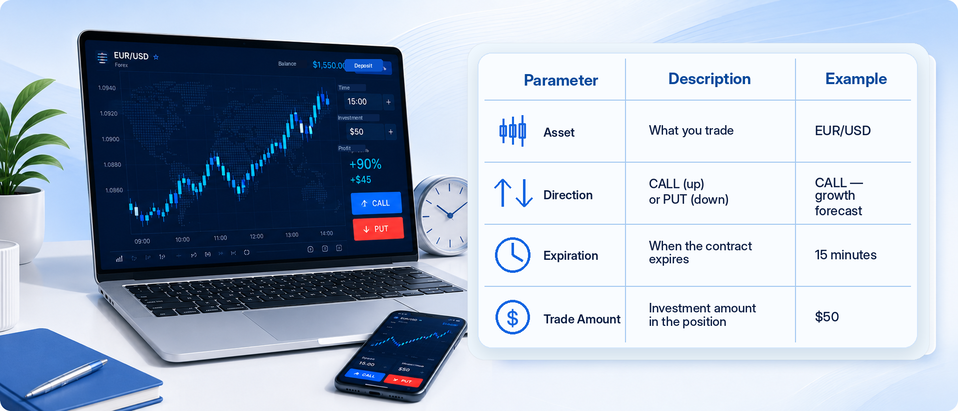
Every trade consists of four parameters that the trader sets before entering:
- Underlying asset — the financial instrument whose price movement the trader is predicting (e.g., EUR/USD, gold, Bitcoin).
- Direction — the trader’s forecast: will the price go higher (CALL) or lower (PUT) relative to the current level.
- Investment amount — the sum the trader is willing to risk on this particular trade.
- Expiration time — the duration of the contract, after which the result is determined (from 60 seconds to several weeks).
After the expiration time elapses, the asset’s price is compared with the entry price (the strike price). If the price moved in the predicted direction, the trade is considered a winner. The payout amount is calculated as a percentage of the invested sum and is stated in advance at the moment of opening: typically between 70% and 95% of the investment volume.
A losing trade usually means the loss of 100% of the investment, although some brokers return 10–15% as an insurance portion. This parameter should be reviewed in the specific broker’s terms and conditions before you start trading.
Types of Binary Options Contracts
Over the years the market has existed, several varieties of binary contracts have emerged. They differ in their winning conditions and execution mechanics.
| Type | Description |
| CALL / PUT (High/Low) | The basic type. A prediction on whether the price will rise (CALL) or fall (PUT) by the time of expiration. This is the most common type of binary options contract and the foundation of binary options trading for beginners. |
| Range (Boundary) | The trader predicts whether the price will stay within a specified range or move beyond its boundaries by expiration. Also known as «In/Out» binary options. |
| Touch / No Touch | A prediction on whether the price will reach (touch) a specified level during the entire contract period. It does not have to be at the moment of expiration — a single touch at any point is sufficient. |
| Ladder | Multiple price levels with different payouts. The further the predicted price is from the current one, the higher the potential payout. This type requires more advanced binary options strategy knowledge. |
| One Touch | A simplified version of Touch. It is enough for the price to reach the target level just once during the contract period. Payouts are usually higher — 200–500%. |
| Spread | Profit depends on the difference between the entry price and the execution price, rather than simply on the direction. Similar to spread betting in traditional financial markets. |
Beginner traders are recommended to start exclusively with the basic CALL/PUT (High/Low) type — it is the most transparent in terms of mechanics and the most predictable in terms of risk.
Binary Options Trade Example
Trade Breakdown: EUR/USD, PUT
Situation: The trader analyzes the EUR/USD chart. The pair’s price is 1.0850. Positive U.S. labor market data has just been released, which historically puts downward pressure on the euro. The trader predicts a decline.
Trade Parameters:
- Asset — EUR/USD
- Direction — PUT (prediction of a price decrease)
- Investment — $100
- Expiration — 30 minutes
- Payout on win — 82%
Scenario A — Winning trade: After 30 minutes, the EUR/USD price drops to 1.0832. The prediction was correct. The trader receives the $100 investment back plus $82 profit (82% of $100). Total return: $182.
Scenario B — Losing trade: After 30 minutes, the EUR/USD price rises to 1.0863. The prediction was wrong. The trader loses the $100 investment. If the broker offers a 10% refund on losing trades, the trader receives $10 back. Net loss: $90.
This example clearly illustrates the asymmetry of binary options: you can earn 82% on a winning trade, but you lose 100% (or 90%) on a losing one. This is why risk management and having a proven binary options strategy are critically important.
Who Is Binary Options Trading For
Binary options are a specific instrument. They are not a universal solution and are far from suitable for all market participants.
Who may find this instrument suitable
Experienced traders with skills in technical and fundamental analysis who want to use short-term market direction predictions. People studying financial markets who want to understand the basic principles of derivative instruments — especially on a demo account. Forex or stock market traders who already have experience and want to diversify their toolkit with binary options trading.
Who binary options are NOT suitable for
Beginning investors without experience in financial markets risk losing their entire deposit in a short period. People considering trading as their sole source of income without a proven system — this is a path to rapid losses. Those who trade with their last savings or borrowed money expose themselves to unjustified financial risk. Binary options should never be treated as a guaranteed income source.
Pros and Cons of Binary Options
Advantages
- Simplicity of mechanics. You don’t need to calculate stop-losses, lot sizes, or leverage. The outcome is binary: profit or loss.
- Predetermined risk. Before entering a trade, you know exactly how much you can lose. There are no margin calls or unexpected drawdowns.
- Low entry threshold. Many binary options brokers allow opening trades starting from $1, and minimum deposits begin at $5–10.
- Short timeframes. Results are available within minutes, which allows for quick strategy testing and learning.
- Wide range of assets. Currency pairs, stocks, commodities, indices, cryptocurrencies — all available on a single platform.
- Demo accounts. Most reputable brokers offer free demo accounts with real market quotes for risk-free practice.
Disadvantages
- High risk of capital loss. Statistics show that 70–80% of retail traders lose money. The «all-or-nothing» structure means losses tend to exceed gains without a disciplined approach.
- Unfavorable mathematical edge. With a typical 80% payout, you need to win more than 55.6% of trades just to break even. The math works against the trader by default.
- Psychological pressure. Short expiration times create intense emotional stress, leading to impulsive decisions and revenge trading.
- Limited regulation. The binary options market is less regulated than traditional financial markets in many jurisdictions, which increases the risk of encountering unreliable brokers.
- No position management. Unlike Forex or stocks, you cannot close a binary option early or adjust your position in most cases (some brokers offer early closure at reduced payout).
Risks of Binary Options Trading and How to Minimize Them
Risk is an inherent part of all trading. When working with binary options, risks are particularly significant due to the «all-or-nothing» nature of the instrument. Understanding risks and managing them is a fundamental skill for any binary options trader.
Main Risks
Market risk. Markets move unpredictably. Even with correct analysis, the price can move against your prediction due to random factors: breaking news, geopolitics, actions of institutional players — all of these influence price movements and can invalidate the most thorough technical analysis.
Psychological risk. Short-term trades create intense emotional pressure. The desire to «win back» losses after a losing streak leads to increasing trade sizes and even greater losses — a classic trader’s trap known as «tilt» or «revenge trading.»
Risk of unpreparedness. Trading without a system, without understanding the basics of technical analysis, and without practice on a demo account turns trading into a random process with a predictably negative outcome over time.
Practical Risk Management Rules
- The 2–5% Rule. Never invest more than 2–5% of your total deposit in a single trade. With a $500 deposit, the maximum trade size should be $10–25. This is the cornerstone of proper money management in binary options.
- Daily loss limit. Set a ceiling for daily losses (for example, 15–20% of your deposit). Once you’ve reached the limit, close the platform. No exceptions.
- Trading journal. Record every trade: asset, direction, reason for entry, result, and emotional state. Analyzing your journal helps identify recurring mistakes and improve your binary options strategy over time.
- Demo account before real money. Test any new strategy on a demo account for at least 2–4 weeks before risking real capital. This is non-negotiable for beginners.
- Never trade on emotions. After a series of losses, take a break instead of trying to «recover» with increased trade volumes. Walk away from the screen for at least 30 minutes.
How to Start Trading Binary Options: Step-by-Step Guide
Step 1: Learn the Basics of Technical Analysis
Without a basic understanding of charts, support and resistance levels, and at least a few indicators (RSI, MACD, moving averages), trading becomes guesswork. Spend 2–4 weeks on education before opening a real account. The «Education» section on TradeInsider contains materials covering all fundamental topics — from technical analysis to trading psychology.
Step 2: Choose a Reliable Binary Options Broker
Research the conditions of several brokers: minimum deposit size, payout percentages, demo account availability, and reviews from real traders. In our «Broker Reviews» section, we analyze popular binary options platforms based on specific criteria — without advertising, with an honest assessment of each one’s pros and cons.
Step 3: Open a Demo Account
Most reliable binary options brokers offer a demo account with virtual money and real market quotes. Use it for at least 3–4 weeks — trading exactly the same way you would trade with real money: with the same trade sizes and risk management rules. A demo account is the safest way to learn how binary options work without financial risk.
Step 4: Develop and Test Your Strategy
Choose one binary options strategy and apply only that one. Keep a trading journal. The goal on a demo account is not maximum profit but consistency: 50–100 trades using one system with honest statistics. Popular beginner strategies include trading support and resistance levels, RSI oversold/overbought zones, and candlestick pattern recognition.
Step 5: Start with a Minimum Deposit
Your first real deposit should be minimal — an amount whose loss would not affect your financial situation. The goal of the first month of real trading is not profit but capital preservation and applying the system you’ve practiced. Many experienced traders recommend starting with $100–200.
Step 6: Keep a Journal and Analyze Your Performance
Record all trades, analyze mistakes, and refine your strategy. Successful traders differ from unsuccessful ones primarily through the systematic nature of their approach. Review your journal weekly and identify patterns in your winning and losing trades.
Verification and Security When Working with a Binary Options Broker
How KYC (Know Your Customer) Verification Works
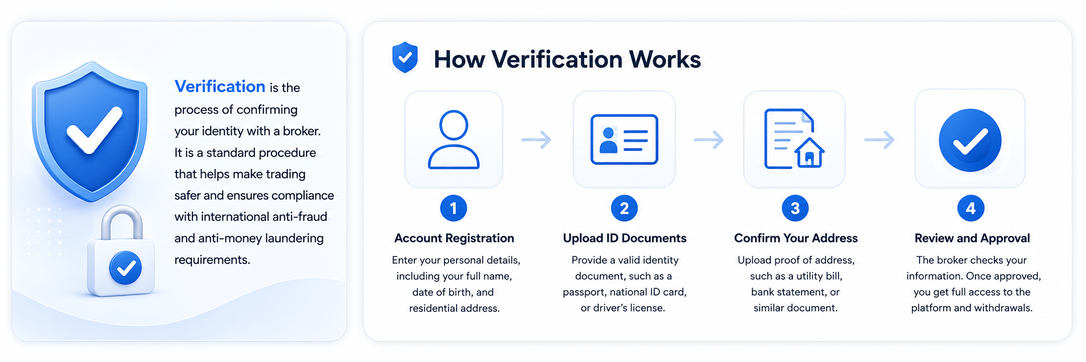
Identity verification is a standard procedure that traders encounter when making their first withdrawal request. It exists to protect the trader: it prevents unauthorized access to the account and confirms that funds are being withdrawn by the account owner.
What is typically required for KYC verification:
- A government-issued identity document (passport or driver’s license) — a photo or scan
- Proof of residential address (utility bill, bank statement) — a document no older than 3 months
How it works in practice: Registration and demo account opening → trading without restrictions → decision to withdraw funds → broker requests documents → after identity verification, funds are sent to the specified payment details.
This approach — verification upon withdrawal rather than upon registration — is used by the majority of binary options brokers. It allows traders to avoid bureaucracy at the start and focus on learning the platform and trading. Verification is completed once and remains valid for all future withdrawals.
What to Look For
Platforms that do not conduct identity verification at all create risks for users themselves: without identity confirmation, it is impossible to protect an account from hacking or funds from theft. The presence of a KYC procedure is a sign that the broker operates within standard financial practices and takes security seriously. In our «Broker Reviews» section, we specify exactly how verification is organized at each particular broker.
Frequently Asked Questions About Binary Options (FAQ)
What are binary options in simple terms?
A binary option is a prediction-based trade. You choose an asset (for example, EUR/USD), predict whether the price will go up or down in 15 minutes. If you’re right, you receive a predetermined percentage of profit. If not, you lose the invested amount. It’s simple in concept, but this apparent simplicity conceals a high level of risk.
Can you make money with binary options?
Technically, yes. However, statistically, the majority of traders (70 to 80%) incur losses over time. Successful binary options trading requires a systematic approach, strict risk management, and a deep understanding of the market. Beginners are strongly advised to start with a demo account and spend at least a month practicing before trading with real money.
What is the minimum amount needed to start trading binary options?
Most binary options brokers have a minimum deposit ranging from $5 to $250. The minimum investment per single trade starts at $1. However, for proper operation while following money management rules, it is recommended to start with no less than $100–200 to allow for meaningful position sizing.
How are binary options different from regular options?
Classic options are traded on regulated exchanges and have variable profit that depends on the depth of price movement. Binary options have a fixed, predetermined outcome: either a fixed profit or a loss of investment. Because of this, they are often called «all-or-nothing options» or «digital options.» Binary options are generally simpler to understand but carry a higher inherent risk due to the fixed loss structure.
What is expiration in binary options?
Expiration is the time when the contract expires. It is precisely at the moment of expiration that the system determines whether the trade closed in profit or loss. Binary options can have expiration times from 60 seconds to several weeks. For beginners, expirations from 15 minutes to 1 hour are recommended, as they provide enough time for meaningful price movement while avoiding the noise of ultra-short timeframes.
Do I need to complete verification to trade binary options?
No — registration, opening a demo account, and trading on a real account do not require verification at most brokers. Identity confirmation (KYC) is typically conducted upon the first withdrawal of funds — this is a standard security procedure that protects the trader’s account and money. The process usually takes 24–48 hours.
What is a demo account and why do I need one?
A demo account is a practice account with virtual money. The quotes are real, the platform functionality is identical to live trading, but the financial risk is zero. Most reliable binary options brokers offer demo accounts without requiring a real deposit. It’s the best way to learn the platform, understand how binary options work, and test a strategy before committing real capital.
How to choose a binary options broker?
Pay attention to withdrawal conditions, demo account availability, payout percentages, real trader reviews, and quality of customer support. A detailed breakdown of selection criteria can be found in our article «How to Choose a Binary Options Broker: 7 Reliability Criteria» in the Education section.
Conclusion: Where to Start with Binary Options
Binary options are a real financial instrument with straightforward mechanics and a low entry barrier. These very qualities make them attractive to beginners. However, attractiveness does not equal safety.
Key takeaways from this guide: risks are high and documented by statistics; the math works against any trader without a systematic approach; choosing a reliable binary options broker is critically important; and education combined with demo account practice is a mandatory step before investing real money.
Start by studying our educational materials, choose a broker from our rating, open a demo account and test your binary options strategy — and only then transition to real trading.
This material is educational in nature and does not constitute investment advice. Trading financial instruments involves the risk of capital loss.
You Might Also Like

What Is Volatility in Trading?
Volatility measures the degree to which an asset's price fluctuates over a given period. High volatility means price is making...

What Is a Turnover Requirement in Binary Options?
A turnover requirement (also called wagering requirement or volume condition) is the total amount of trading volume you must generate...

Stochastic Oscillator Guide 2026: How to Read Signals
Table of Contents What Is the Stochastic Oscillator? How the Stochastic Oscillator Works Reading the Stochastic Panel — %K and...